Backend system design · 1 of 4
- Backend system design quick revision · you are here
- Caching with Redis
- Rate limiting
- Race conditions in limits and codes
What this page is for
Intent: revise caching, rate limiting and race conditions in one go, the night before an interview.
Covers: Redis basics · cache-aside vs write-through · TTL and jitter · invalidation · cache stampede · fixed window · sliding window · token bucket · limiting a login endpoint · lost updates · check-then-act.
Time: about 10 minutes. Every topic below links to its quick page and its detailed page.
Words you need first
- Redis: an in-memory key-value store. Very fast, shared by every server instance, and it runs one command at a time, so each single command is atomic (it can’t be split by another request).
- Source of truth: the copy you trust, here Postgres on disk. Cached copies in Redis can be rebuilt from it. Rate-limit counters and cooldown keys live only in Redis, so decide what happens if Redis loses them (fail-open or fail-closed).
- Cache hit / cache miss: the key was in Redis / it wasn’t, so you go to the database.
- Stale read: serving an old copy after the real data changed.
- TTL (time to live): a timer on a key, set with
EX(seconds). When it runs out, Redis deletes the key.TTL keyreturns-2if the key doesn’t exist and-1if it has no expiry. - Jitter: a small random amount added to each TTL so keys don’t all expire together.
- Invalidation: deleting a cached copy because the real data changed.
- Cache stampede: one popular key expires and many requests miss at the same moment.
- Rate limiting: capping how many requests an identifier (IP, user, hashed email) may make in a time span. A limit is a ceiling: at most N.
- 429 Too Many Requests: the status code for “slow down”, sent with a Retry-After header in seconds.
- HMAC: a keyed one-way hash (here HMAC-SHA256). It can’t be reversed. It is not encryption.
- Race condition: the result depends on the timing of requests that run at the same time.
- Lost update: two requests read the same value, both add one, both write, so one update disappears.
- Check-then-act: read a value, decide, then write, with a gap in between where another request can slip in.
SET key value NX EX n: set the key only if it doesn’t exist, with an expiry. Atomic, so only one request wins.SELECT ... FOR UPDATE: read a row and lock it until the transaction commits, so other requests wait their turn.
The big picture
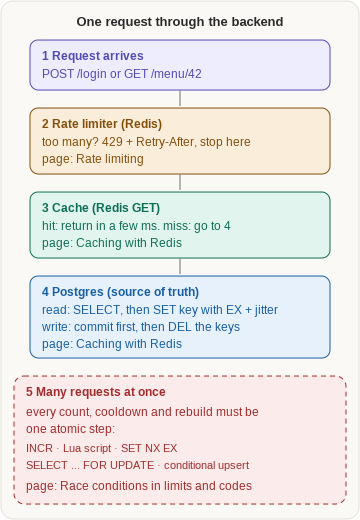
Every topic is one step of handling a request, and the red box applies to all of them:
Topic by topic
1. Caching with Redis
- Simply: check the fast copy first; if it’s missing, read the database and save a copy with a timer.
- Cache-aside (the default): read =
GET→ on a miss,SELECTfrom Postgres →SET key value EX ttl. Write = update Postgres, commit, thenDELthe key. The next read refills it. - Write-through: write = update Postgres, then
SETthe new value right away, so the cache stays warm. Two writers’SETs can land out of order and leave the old value until the TTL ends. Fits a single writer with many readers, like a restaurant’s “open now” flag. - TTL is the safety net: it caps how long a stale copy can live (at most one TTL). Short TTL is fresher with more database load; long TTL is the reverse. Jitter (for example 300 ± 30 s) stops keys cached together from expiring in the same second.
- Invalidation:
DELafter the commit, and delete every key that holds a copy. Deleting before the commit lets a reader put the old value back (stale repopulation). Commit-then-delete closes most of that gap, not all of it: a reader that read the old row just before the commit can still write it back after the delete, which is one more reason every key keeps a TTL. - Stampede: one hot key, many misses at once. Fix:
SET lock:key 1 NX EX 10, so one request rebuilds and the rest wait, then hit. The lock needs an expiry, or a crashed winner leaves it stuck forever. - Trap: a TTL doesn’t make data stale; it limits how long stale data survives. And jitter fixes many keys expiring together, not a stampede on one key.
- Quick · Detailed
2. Rate limiting
- Simply: count each user’s recent requests in Redis, and say “429, try again later” when they pass the limit.
- Why Redis, not server memory: with several servers or serverless, each instance has its own memory, so 3 instances with a limit of 5 allow 15. Redis is one shared counter, updated atomically.
- Fixed window: one counter per clock minute (
INCR, expiry on the first hit). Cheap, but the boundary burst allows up to 2× the limit across the window edge. - Sliding window: counts requests in the last N seconds from now, so there’s no edge to exploit. The log version stores a timestamp per accepted request (exact, at most
limitentries per key, so memory grows with the number of keys); the counter version weights the previous window (constant memory, an approximation). Upstash’sslidingWindowis the counter version. - Token bucket: capacity = the biggest burst allowed, refill rate = the steady speed. Good for bursty traffic, not for login.
- Login endpoint: sliding window, 5 per 30 minutes, keyed by an HMAC of the normalised email, checked before the password. Add a looser per-IP limit against password spraying (one password tried across many accounts). Decide fail-closed (block when Redis is down) or fail-open (allow and log).
- Trap: “at least 5 attempts” is wrong; a limit is at most 5. And HMAC is not encryption.
- Quick · Detailed
3. Race conditions in limits and codes
- Simply: if two requests can both read the same value before either writes, the limit can be skipped. Make the check and the write one step.
- Lost update: read 4, both write 5, both allowed. Fix with one atomic command:
INCR, a Lua script, orUPDATE ... SET n = n + 1. - Check-then-act: an email code’s 60-second resend cooldown reads
last_sent_at, then writes. Two clicks both pass, two emails go out, and the first code silently stops working. Fix:SET otp:cooldown:<id> 1 NX EX 60, or one conditional upsert. - Verifying a code is safe with
SELECT ... FOR UPDATEin a transaction: parallel guesses wait their turn, so the 5-guess cap is exact. - Logic gap: if each resend resets the wrong-guess counter, someone gets 5 new guesses every minute. Add a daily resend cap.
- Trap: “serialised” (one after another) is not the Serializable isolation level. And
FOR UPDATEalone doesn’t fix check-then-act when there’s no row to lock yet. - Quick · Detailed
Top questions
What's the difference between cache-aside and write-through?
Cache-aside fills the cache on a read miss and deletes the key on write. Write-through updates the cache with the new value on every write, so reads are always warm.
Why delete the cache key on write instead of updating it?
Two concurrent
SETs can land in the wrong order and leave an old value. Deletes don’t depend on order; the next read loads the current value.
What does a TTL protect you from?
A missed or failed invalidation. It caps how long a stale copy can survive.
Why add jitter to TTLs?
Keys cached at the same moment would all expire in the same second and spike the database. Jitter spreads their expiry out.
What goes wrong if you delete the cache key before the transaction commits?
A reader misses, reads the old committed value, and puts it back in the cache. After the commit the cache is stale until the TTL ends.
What is a cache stampede and how do you prevent it?
One hot key expires and many requests rebuild it at once. Use a
SET NX EXlock so one request rebuilds while the others wait, or serve the stale value while one request refreshes.
Why must the stampede lock have an expiry?
If the request holding it crashes, the lock frees itself instead of blocking every future rebuild.
Why use Redis for rate limiting instead of a counter in memory?
Each server instance has its own memory, so the limit multiplies by the number of instances. Redis is one shared, atomic counter.
What's the weakness of a fixed window?
The boundary burst: up to twice the limit across the edge between two windows.
How does a sliding window fix it?
It counts requests in the last N seconds from now, so the window moves with time and there’s no edge.
When would you choose a token bucket?
When short bursts are normal but the average rate must be capped, like search as you type. Capacity sets the burst, refill sets the steady rate.
What status code and header does a rate limiter return?
429 Too Many RequestswithRetry-Afterin seconds.
Why hash the email with HMAC before using it as a Redis key?
The cache never stores real emails, and the secret key stops anyone reversing the hash with a list of known emails. It’s a one-way hash, not encryption.
A login limit is per email. How can an attacker get around it?
Password spraying: one common password across many emails from one IP. Add a per-IP limit and count failed attempts.
What does fail-closed mean for a rate limiter?
If Redis is down, block the request. It favours security over availability; fail-open favours availability.
What is a lost update?
Two requests read the same value, both change it, both write, and one change is lost. Fix with an atomic command or a row lock.
What is a check-then-act race?
Reading a value, deciding, then writing, with a gap where another request can do the same. Make the check and the write one atomic step.
How does
SELECT ... FOR UPDATEkeep a 5-guess limit exact?It locks the row until commit, so parallel guesses run one after another and each sees the updated count.
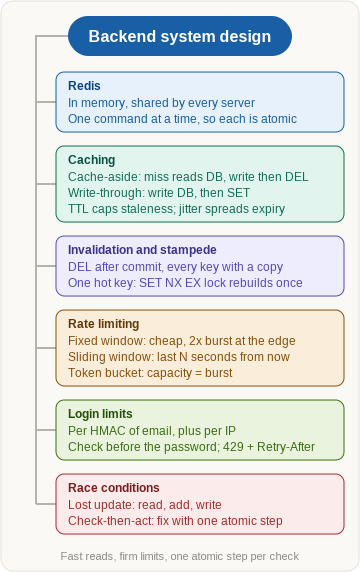
Mental map
Watch
ByteByteGo, about 6 minutes: where caches sit in a system (browser, CDN, load balancer, application, database) and why each one helps. For rate limiting, use the video on the Rate limiting page.