Databases and SQL · 3 of 5
What this page is for
Intent: how two tables are joined, why
ONandWHEREdiffer, and how to find rows with no match.
You’ll learn: inner vs left join · ON vs WHERE · the NULL trap · NOT EXISTS · duplicates.
Time: about 8 minutes. The detailed Joins page repeats each section with every step table.
Words you need first
- Table: rows and columns, like a spreadsheet.
- Primary key: the column that names each row once, such as
customers.id. It is never NULL. - Foreign key: a column that holds another table’s primary key.
orders.customer_idpoints atcustomers.id. - Join: combines rows of two tables where a condition matches.
- NULL: “no value”. Not zero, not an empty text. Test it with
IS NULL, because= NULLnever matches. - Inner join: keeps only the pairs that match on both sides.
- Left join: keeps every row of the left table (written first). Missing right-side values are NULL.
- Anti-join: rows of one table with no match in another, such as “never ordered”.
- RIGHT JOIN keeps every row of the right table. FULL OUTER JOIN keeps every row of both. Both are rare. A right join is a left join with the tables swapped.
Why it exists
A join puts split tables back together for one question.
The picture
How it works, with an example
Simply: A join combines rows from two tables when a column matches. Each order holds its customer’s id, which is a foreign key: a column that stores another table’s key. Think of a student card that names its class. Many students share one class, so the link sits on the student side.
What to know: A join pairs rows where its ON condition is true. Here that condition is customers.id = orders.customer_id.
Only the columns joins need are shown.
customers
| id | name |
|---|---|
| 1 | Riya |
| 2 | Kabir |
| 3 | Meera |
| 4 | Arjun |
restaurants
| id | name |
|---|---|
| 1 | Spice Hub |
| 2 | Dosa Den |
| 3 | Burger Bay |
orders
| id | customer_id | restaurant_id | status | created_at |
|---|---|---|---|---|
| 101 | 1 | 1 | delivered | 2026-10-28 13:05 |
| 102 | 2 | 2 | delivered | 2026-10-28 20:40 |
| 103 | 1 | 3 | cancelled | 2026-10-29 19:15 |
| 104 | 3 | 1 | delivered | 2026-10-30 12:30 |
| 105 | 1 | 1 | delivered | 2026-10-31 21:10 |
The link is on the order: customer_id. The customer row has no order column. Many orders point at one customer, so the foreign key sits on the many side.
The most common mistake
Two slips that cost points
- Writing
customers.orderId. The link isorders.customer_id.- Thinking WHERE removes rows with no join partner. The join does that. WHERE only sees rows the join kept.
Inner join and WHERE: two filters
Simply: Think of a bouncer at a club door. The join is the bouncer: it lets in only rows that have a partner in the other table, and turns away the rest. WHERE is a second check on the rows already inside. Taking WHERE away would not let back in the rows the bouncer refused.
What to know: The join runs first, using its ON condition, and drops rows with no partner. WHERE runs after the join and only checks the rows the join kept, so it can never bring back a dropped row.
Example: every delivered order, with names, newest first.
SQL
SELECT o.id AS order_id, c.name AS customer, r.name AS restaurant, o.created_at
FROM orders o
JOIN customers c   ON c.id = o.customer_id
JOIN restaurants r ON r.id = o.restaurant_id
WHERE o.status = 'delivered'
ORDER BY o.created_at DESC;
Drizzle
db.select({ orderId: orders.id, customer: customers.name, restaurant: restaurants.name, createdAt: orders.createdAt })
  .from(orders)
  .innerJoin(customers, eq(customers.id, orders.customerId))
  .innerJoin(restaurants, eq(restaurants.id, orders.restaurantId))
  .where(eq(orders.status, 'delivered'))
  .orderBy(desc(orders.createdAt));
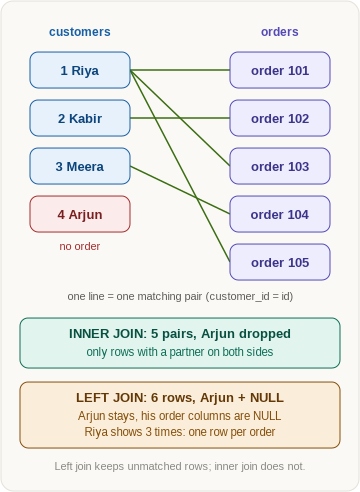
After the join (5 rows). Arjun is missing, because he has no order:
| order | customer | restaurant | status |
|---|---|---|---|
| 101 | Riya | Spice Hub | delivered |
| 102 | Kabir | Dosa Den | delivered |
| 103 | Riya | Burger Bay | cancelled |
| 104 | Meera | Spice Hub | delivered |
| 105 | Riya | Spice Hub | delivered |
Result, after WHERE removes 103 (4 rows):
| order | customer | restaurant | created_at |
|---|---|---|---|
| 105 | Riya | Spice Hub | 2026-10-31 21:10 |
| 104 | Meera | Spice Hub | 2026-10-30 12:30 |
| 102 | Kabir | Dosa Den | 2026-10-28 20:40 |
| 101 | Riya | Spice Hub | 2026-10-28 13:05 |
Why this, not that:
- The join drops a row with no partner (Arjun). WHERE drops a row that fails a condition (103, which is cancelled, though it has a partner).
Trigger card
When I need only rows with a partner in both tables, I use
JOIN, because a row with no partner has nothing to pair with.
Does WHERE remove rows that have no join partner?
No, that is a common slip. The join removes them first. WHERE only checks rows that survived the join.
Is
customers JOIN ordersthe same asorders JOIN customers?For an inner join, yes: the same rows. A left join is not symmetric, because the left table decides which rows are kept.
Left join and anti-join: who never ordered
Simply: Think of a class register. Every student has a line, even when absent, and an absent student gets a blank called NULL. A left join works the same way: it keeps every row of the left table, with NULL where nothing matches. To find the rows with no match, look for the blanks, which means keeping the rows where the other table’s id IS NULL.
What to know: A left join keeps every row of the left table and fills the right side with NULL where nothing matches. Test the right table’s id, such as orders.id IS NULL, and put the match in ON, because a right-table filter in WHERE turns the left join into an inner join.
Example: customers who never ordered.
SQL
SELECT c.id, c.name
FROM customers c
LEFT JOIN orders o ON o.customer_id = c.id
WHERE o.id IS NULL;
Drizzle
db.select({ id: customers.id, name: customers.name })
  .from(customers)
  .leftJoin(orders, eq(orders.customerId, customers.id))
  .where(isNull(orders.id));
After the left join (6 rows). Riya appears three times, once per order:
| c.id | name | o.id |
|---|---|---|
| 1 | Riya | 101 |
| 1 | Riya | 103 |
| 1 | Riya | 105 |
| 2 | Kabir | 102 |
| 3 | Meera | 104 |
| 4 | Arjun | NULL |
Result, after WHERE o.id IS NULL: 4 · Arjun.
Why this, not that:
- LEFT JOIN + IS NULL works on any data. NOT IN (
WHERE id NOT IN (SELECT customer_id FROM orders)) returns no rows at all if the list has one NULL, because4 <> NULLis unknown. NOT EXISTS (WHERE NOT EXISTS (SELECT 1 FROM orders o WHERE o.customer_id = c.id)) is NULL-safe. - Test the right table’s id (
orders.id). Only the joined side gets NULLs. Testingcustomers.idfinds nothing. - Match in ON, not WHERE. A right-table filter in WHERE turns a left join into an inner join:
WHERE o.status = 'delivered'removes Arjun, whose NULL status fails.
Trigger card
When a question says “never”, “no”, or “even with none”, I left join from the table that must keep every row, then keep the rows where the other table’s id IS NULL.
Can you start from orders to find customers who never ordered?
No. A customer with no orders has no row in
orders. Start fromcustomers.
Why does Riya appear three times?
A join makes one row per matching pair. Riya has three orders, so three pairs. That is how joins duplicate rows.
Why is NOT IN risky?
One NULL in its list makes it return no rows at all, with no error. Use NOT EXISTS.
Say it in an interview
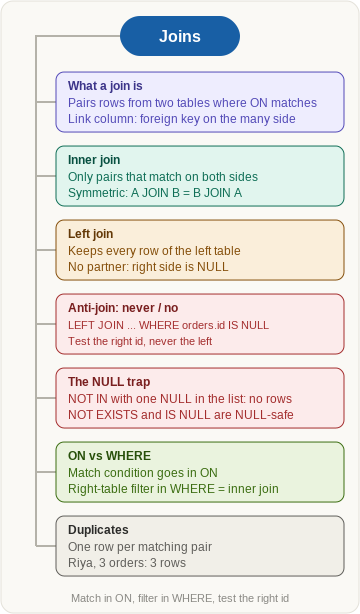
“A join combines rows from two tables where a condition matches, usually a foreign key on the many side. An inner join keeps only matched pairs. A left join keeps every row of the left table and fills the right side with NULL. To find rows with no match, I left join and keep the rows where the right table’s key IS NULL. The match goes in ON, and a right-table filter in WHERE turns the left join into an inner join. I use NOT EXISTS rather than NOT IN, because one NULL makes NOT IN return nothing.”
Questions interviewers ask
Tap a question to see the answer.
Inner join vs left join?
Inner keeps only matched rows. Left keeps every left-table row, with NULLs where nothing matches.
Where does the foreign key live?
On the many side: each order has one customer, and a customer has many orders.
ON or WHERE for a filter in an outer join?
ON decides which rows match, so unmatched left rows stay. WHERE filters after the join.
What is an anti-join?
Rows of one table with no match in another. Left join, then keep rows where the other table’s id IS NULL.
Why does NOT IN break with NULL?
The comparison with NULL is unknown, and WHERE keeps only true rows. One unknown in the list makes every row fail. NOT EXISTS is safe.
What is a NULL foreign key in a join?
It never matches anything, not even another NULL. An inner join drops that row.
How do you join on two columns?
ON a.x = b.x AND a.y = b.y. Both pairs must match.
Why can a join return more rows than its starting table?
One row can match many; each pair is a row.
Mental map
Watch
Socratica, about 10 minutes: an overview of SQL joins and the basic join types.
Want more? The detailed Joins page adds every step table, the wrong versions and harder questions. Next: Aggregates: GROUP BY and HAVING.
← Transactions and concurrency · Aggregates: GROUP BY and HAVING →